Our Mission
GreenDex was created with the primary goal of educating and empowering consumers to make informed decisions at checkout. Our mission is to provide transparency around corporate practices so that individuals can align their purchases with their values. Looking ahead, we hope GreenDex will be widely adopted, creating meaningful pressure so companies act responsibly we can discourage them from profiting through harmful or unethical behavior.
What ESG Is
ESG stands for Environmental, Social, and Governance. These three categories are benchmarks that assess a company's overall ethical standing. Typically ESG is used in SEC filings and evaluating if a company is doing what it needs to be considered a net positive impact on the world. In recent years ESG has fallen out of fashion, as it was predominantly used as a metric for investing instead of a tool for public knowledge. Our goal at GreenDex is to spread awareness of ESG while promoting companies that follow these guidelines and suggesting alternatives where we can.
Letter Grades & Unique Identifiers
Letter grades our way of knowing at a glance how ethical a company is based on 19 different metrics. We have also started onboarding organizations and indivudals into our platform and gave them their own unique identifiers (I for indidvuals, and O for organizations) in order to make it clear for frequent users of the platform. N & R grades are also unique and stand for Not graded (we do not have enough data) and R for removed (a company requested we remove thier grade from GreenDex.
Any block you see in GreenDex tagged with a letter A through F represents its grade based on a typical grading scale. A grade is anything between 100 and 90, B is from 89 to 80, C is 79 to 70, D is 69 to 60, and F grades are anything below 60. These grades are based on a companies size and 19 public ESG metrics.
Individuals are vendors with products that want a platform to promote their stuff. We believe small ideas turn into large ones with the support of local communities but are often overlooked with social media. and large companies owning the attention economy. We wanted to give that attention back to those shining stars. and connect their stuff to users in a meaningful way. For all of these reasons, grading individuals seemed wrong. as they are not companies, which is why we've given them their own unique identifier.
Organizations are groups of people that offer something to the community. Oftentimes organizations will have events or calls to action that they are able to broadcast. in GreenDex. You can track and RSVP for these events and find out what is going on in your area. Organizations are also ungraded because they are pre-vetted & have a different set of standards. They must pass to be listed in GreenDex. We publish their applications in their profile in the event people wanted to view / vet an organization for their own personal standards.
The N grade indicates to our users that the company they are viewing does not have enough public information for us to grade. Because we want to do our job the best we can, we decided It was in our users' best interest to still be able to find the company they are searching for. and disclose that we don't have information as opposed to returning a blank search.
R grades were implemented to keep GreenDex safe. In the event a company reaches out to us and attempt to threaten us based on the system we've created, we can update their grade to R for "removed." Companies that have R grades aren't to be viewed as positive or negative. They've just gone through proper channels to not disclose their letter grade. As all information Public users will still be able to view their ESG information, but not our GreenDex letter grade.
Articles & Media
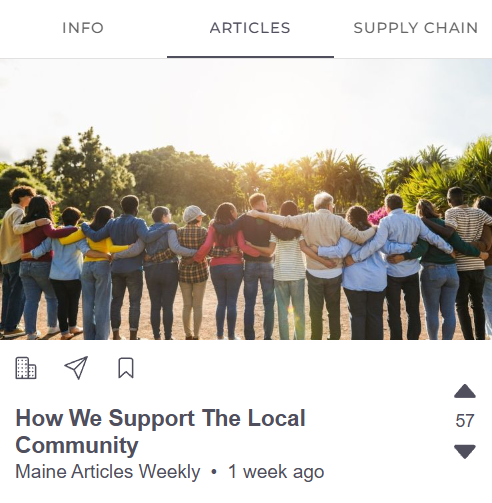
As a platform that grades companies based on public ESG data we accept that data and analytics can be behind current events that come up. Thats where our articles & media come into play. We scan the internet for new articles and content then upload and back link them to companies. We are also able to track those articles to historical stock dat lining up controversy and price action for interested investors. With our 1.4 update we are also giving approved companies, organizations, and indivudals the ability to post content so they can showcase what they do for the community.
Events
GreenDex events focus on local, organized community activities. Companies and organizations are encouraged to share events they have. Users will be able to view these events and RSVP for them if they so desire. All public events in the user's radius (default 50 miles) will be chronologically ordered from the oldest to newest, with the oldest displayed event being 2 months in the future.
Deal Breakers
At GreenDex we put time into making sure our grading system is accurate and fair. We know some users may not share our opinion to a tee, which is why we wanted to give that power back to the user. Dealbreakers can be toggled for individual metrics or entire categories. When turned on, warning icons display on companies, similar to how badges are by default.
WikiRate & Data Sourcing
GreenDex primarily sources its data from an open-source ESG platform called WikiRate. WikiRate works closely with organizations to gather data on companies. Our platform is mainly an extension of this data, categorizing and displaying that data in an easy-to-digest score for the public since manual research for any individual company could take hours or days of effort if you are looking to compare dozens of metrics quickly. We have also created several in-house tools to gather information, and in our best effort to support the platform, we contribute data we get back to WikiRate. Given the latter, our platform will run into reporting errors, and while infrequent, they are important to report and correct in order to ensure accurate scores!
Badges
Badges are important metrics we have collected that are not broadly reported across all companies in GreenDex. In order to get the full picture and help users understand what their personal red lines should be, they can use badges to identify how a company acts in broad daylight. We also recognize that not every company has bad intentions, so in the event that our systems find nothing bad to report, a green badge can appear detailing something positive about a company.
Location Services
GreenDex has implemented location services so users can find the best local options fast! With location services turned on, the highest-graded local companies will appear at the top of the companies page. Events are also location-based and can help users find low-cost events that will help them get active in the community!
Filters
In the app on the company and media pages users will find a button on the top left of their screen. This is the filters button and allows users to search through the GreenDex application effectively. Company filters allow users to easily view specific E, S, or G grades instead of the sum, and media filters allow users to sort by the types of media they find in search.
Scanning & Open Food Facts
The scanning tool inside of GreenDex allows users to scan any bar code and link it back to a company / brand / or reported owner of the product. Using Open Food Facts' public reference as a base, we have been able to compile this real-time scanner and have done our best to identify parent-child associations in supply chains so our users can unearth who is benefiting from any individual sale.
Supply Chain Information
Detailed in each company profile is a section noted as supply chain information. Here we store the WikiRate known supply chain connections a company has, such as suppliers, subsidiaries, parent companies, brands of, vested interests (shareholders of), supplied by, and owned brands. Future updates could include a physical representation identifying categories with physical links and nodes to give users a better picture of how their money travels.